


AI in Schools: 3 Practical Insights from Trust Leaders at MATPN
AI in Schools: 3 Practical recommendations from Trust Leaders at MATPN AI and embracing digital tools were a big topic of conversation at the MAT Partnership Network event this month. Across the sessions, and in many of the informal conversations with trust leaders in between, there was a real interest around what these technologies might enable. At Fruitify, those we talked to were genuinely excited about faster feedback for pupils and better insights for teachers, the potential is clearly exciting. But alongside that excitement, there were also some thoughtful reflections about how new technology fits into the day-to-day reality of schools. When school leaders talk about AI, the possibilities are easy to see. In the best cases, digital systems allow teachers to spend more time supporting pupils and less time on administration. And importantly, most leaders don’t see this as replacing teachers. Instead, the aim is to support professional judgement and make it easier for teachers to adapt learning in real time. 1. Schools are complex environments One of the themes that came up repeatedly during conversations at MATPN was how carefully trusts must think about introducing new systems. Schools already rely on a range of digital platforms, from MIS and safeguarding systems, to attendance, behaviour and curriculum tools. Each serves an important purpose, but together they create an environment where every new addition needs to be considered carefully. Trust leaders often think not just about whether a tool works well, but about questions such as: How will this fit with the systems we already use? How much training will staff need? Will teachers find it simple to make part of their daily practice? In other words, the conversation is rarely just about whether the technology itself is good. Key Takeaway: Trust leaders will need to consider how new tools fit within the wider ecosystem of the trust. 2. Coherence Another interesting observation from MATPN was around the number of highly specialised tools now available. There are impressive platforms designed for specific subjects, specific assessment types, or specific year groups. Many of them offer innovative features and real potential benefits. But from a trust perspective, leaders often must think about the bigger picture. Rather than introducing different platforms for different parts of the curriculum, many trusts are increasingly interested in solutions that can work across multiple subjects and stages, helping to create a more coherent experience for teachers and pupils, while promoting cross department collaboration. That doesn’t mean specialist tools can’t have value. But it does highlight how important simplicity and consistency are, when systems are being used across an entire trust. Key Takeaway: Trust leaders should think about the bigger picture and need a solution the can work across multiple subjects and stages. 3. Technology that supports teachers Another point that came up in several conversations was the role technology should play in the classroom. Most leaders were clear that the goal is not to replace teachers’ professional judgement. Instead, the most valuable systems are those that support teachers with things like timely insights. For example, providing pupils with quicker feedback can help keep learning moving forward, while also giving teachers useful information about where support might be needed. When technology works well in schools, it tends to feel less like a separate system and more like a natural extension of the teaching and learning process. Key Takeaway: Tools that position themselves as better than teachers risk creating resistance, while those that support teachers’ professional judgement are far more likely to be embraced. Final thoughts Events like MATPN are a useful reminder that schools are incredibly thoughtful about the technology they adopt. There is genuine enthusiasm for innovation and for the possibilities that AI and digital systems bring. But there is also a strong focus on making sure that technology is introduced in ways that genuinely support teachers and pupils. As AI continues to develop, the challenge, and therefore also the opportunity, will be ensuring that new tools fit well within the realities of schools, helping to simplify processes, support teaching, and improve outcomes for pupils. Because ultimately, the goal isn’t just to introduce new technology just for innovations sake. It’s to make sure that technology actually works for schools in a way that genuinely improves learning. At Fruitify, these are exactly the kinds of conversations we find most valuable. Hearing directly from trust leaders about the realities of introducing new technology helps us shape how we think about building tools that genuinely support teachers. If you’re interested in how Fruitify could work in your trust or school or want to know more, click here.
Analysing the Impact of Targeted Feedback on Student Progress
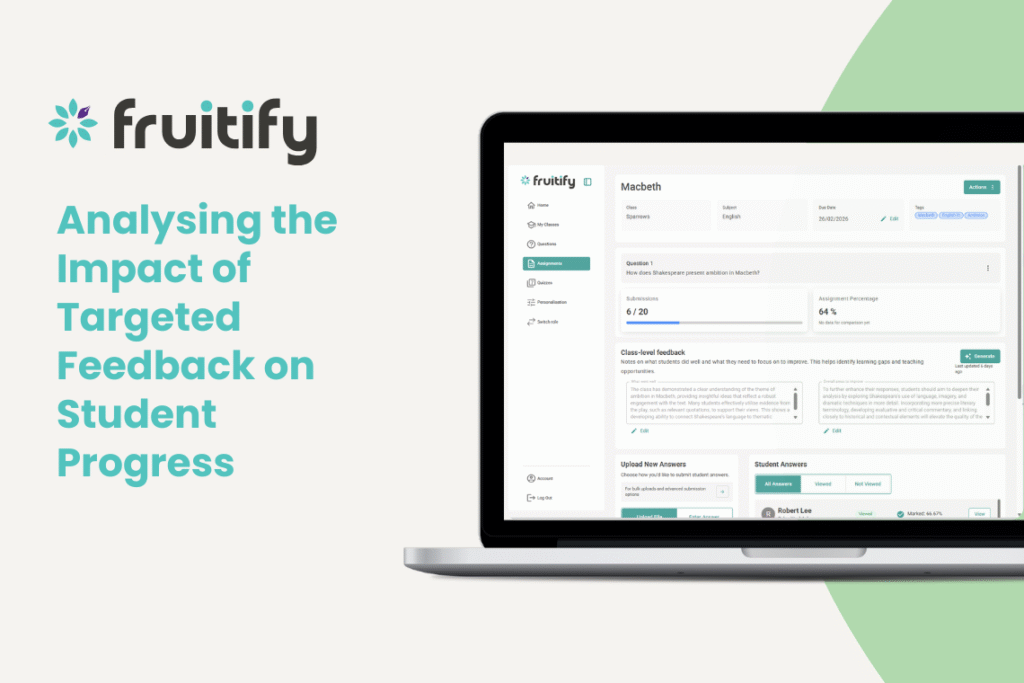
We took a deep dive into five weeks of data from one school using Fruitify, an AI-supported assessment system designed to provide task-linked feedback on extended written responses, and the results are crystal clear: when teachers gave structured, timely feedback using Fruitify, student performance really took off and stayed high! Key outcomes: 📈 14.2 percentage point increase in attainment within one week 📊 15% total improvement over five weeks 📉 22% reduction in attainment gap (standard deviation) ✅ Statistically significant impact (p = 0.0087) 🔁 Sustained improvement across new topics — not a short-term spike The difference was simple but powerful: pupils received actionable feedback much faster using Fruitify than they would usually. The result was not just higher averages but greater consistency across the class. The Starting Point To get a good starting marker, pupils answers were loaded into Fruitify for two weeks, in which they averaged 45.2 % and 41.8 % in Week 1 and Week 2 respectively, with a notable and wide attainment spread between top and bottom performing students. The Intervention: Shortening The Feedback Loop Between Week 2 and Week 3, the teacher introduced timely, actionable feedback through Fruitify. Instead of: A mark/score days or a week later General comments Moving on to the next topic Pupils received: Timely, actionable feedback on what went well A personalised evaluation that is structured, and linked to Assessment Objectives Clear next steps for improvement Feedback stopped being retrospective and became enlightening. The Impact: In One Week The class then repeated the same assessment, and one week later: Class average rose from 41.8% to 56.0% A 14.2 percentage point increase Statistical significance confirmed (p = 0.0087) In practical terms, the improvement was highly unlikely to be random. The feedback changed outcomes. The Strategic Finding: Closing The Gap & Raising The Bar For All What matters for Trust leaders is not just uplift; it’s sustainability, and ongoing improvement. Over Weeks 4 and 5, as pupils moved onto new content: The class average climbed further to 60.2% A 15% total increase across five weeks The attainment gap narrowed by 22% This wasn’t a short-term spike. Or a case of practice makes perfect on one assignment/ question when repeated. The feedback intervention actually created a new, higher baseline of performance. Lower-attaining pupils made the strongest gains, which demonstrates how fast, actionable feedback can help level the playing field for SEND pupils, who are often held back by working memory and anxiety issues. Why This Matters at Trust Level For teachers, schools and leaders with Multi-Academy Trusts, three strategic implications stand out: Feedback timing directly affects attainment: When students receive and act on feedback immediately, understanding stabilises before misconceptions embed. It reduces variability, not just raises averages: Closing gaps improves predictability of outcomes – critical for trust-wide performance oversight. It improves impact without increasing marking burden: Using Fruitify did not require additional teacher hours, on the contrary, it reduced marking burden and delivered smarter, more timely feedback. The Big Question If one class can increase attainment by 15% over five weeks by shortening and improving the feedback loop, the question becomes what this might look like for a whole school or Trust. In this trial, reassessment was made feasible within the same learning cycle without requiring additional marking time — allowing pupils to act on feedback before moving on to new content. As the class progressed to subsequent topics, the improvement in performance was sustained, suggesting that acting on feedback immediately may support a more stable understanding of assessment objectives across future work. Applied consistently across subjects, this approach may offer a pathway towards Trust-wide improvements in attainment.
How Feedback, Not Grades, Drives Student Learning
In traditional education systems, grades are often viewed as the endpoint of learning. A single letter, or number, has often been seen as the marker of success, or failure. Yet, research and evidence increasingly suggest that it is feedback, not grades, that truly drives meaningful student progress. At Fruitify, we’re on a mission to empower educators with intelligent feedback systems that elevate student learning through clarity, reflection and growth. So, why does feedback matter more than grades? Feedback Accelerates Learning Grades indicate performance at a given moment, but they rarely show students how to improve. Feedback, by contrast, provides clarity and direction on what has been mastered and what comes next relative to learning goals or outcomes. The Education Endowment Foundation reports that high-quality feedback can accelerate learning progress by 5-7 months in a single school year, also finding feedback to be especially beneficial for low attainers compared to high attainers. This highlights the importance of feedback in giving every student an equal chance to succeed, a key component of Fruitify’s mission to level the educational playing field. Various studies cite the beneficial effects of feedback on learning outcomes, so, the lesson is clear: when students understand their progress and receive actionable guidance, they learn faster and achieve more compared to receiving a standalone grade. Feedback Enhances Motivation, Grades can Demotivate Grades alone often can often create fixed perceptions of ability – “I’m an A student” or “I’ll never get above a C”. For lower-attaining students, poor grades can be especially discouraging, diminishing their motivation to try again, as shown in Butler’s 1988 study. By contrast, feedback focuses attention on the process of learning rather than the final outcome. Ruth Butler’s influential research showed that students receiving grades alone were less motivated, while those who received task-based comments showed higher engagement and willingness to improve. Whilst some call for gradeless marking in schools, inaccurately citing Butler’s works to support this contention, the study actually supports the use of “task-involving individual comments” i.e. those related to students’ task performance instead of “ego-involving numerical grades” which are based on students’ relative standing among classmates. At Fruitify, we understand grading is necessary for tracking performance and improvement, but we want to ensure it is an equal, beneficial process for students. Our marking system is bias-free, with no student information used in the marking process, providing informative, individual comments on specific achievement objectives to guide progress and ensure every student has an equal opportunity to succeed. Feedback Fosters Reflection and Mastery Standalone grades close conversations, feedback opens them. Constructive feedback prompts learners to reflect, self-assess, and iterate. Over time, this fosters resilience and a growth mindset, skills that extend far beyond academic results. Research consistently shows that feedback-rich environments help students regulate their own learning. In practice, this means students shift from asking “What grade did I get?” to “What can I do better next time?”. This subtle but powerful change builds habits of reflection and continuous improvement. The Role of Technology in Scaling Feedback If feedback is so powerful, why isn’t it central to every classroom? The reality is time. Teachers with 30+ students cannot provide personalised, detailed feedback for every piece of work without overwhelming their workload (which many do!). This is where technology can change the equation. AI-powered tools, like Fruitify, now make it possible to deliver instant, personalised feedback at scale, without replacing teacher expertise. Fruitify handles the repetitive elements: suggesting targeted improvements, tracking progress and general admin, whilst also providing accurate predicted marks with explainable reasoning and editable teacher feedback, blending automation with human judgment. This reduces teachers’ workloads giving them a helping-hand in marking, allowing them to focus on dialogue, mentorship and higher-order learning. A recent 10-week study across Australia and New Zealand found AI-powered feedback facilitated a 47% average improvement in quality of student responses, whilst 87% of students re-engaged with low-scoring work when given the opportunity to revise via the AI feedback loop. Final Thoughts Feedback is clearly the key to unlocking student potential, but comments must be task-specific, future-orientated and unbiased to drive student learning and progress. Whilst there is much negativity surrounding grades, we understand that they are a key performance tracker across schools. Fruitify bridges the gap between grades and feedback, combining the two with rational, personalised and task-specific comments to support grade decisions and guide student progression to ensure improvement. Like teachers and schools across the globe, we are on a mission to positively impact student learning experiences and transform lives through teaching, and Fruitify is the tool to help achieve this mission. To learn more about how Fruitify can revolutionise your classroom, contact us here. In traditional education systems, grades are often viewed as the endpoint of learning. A single letter, or number, has often been seen as the marker of success, or failure. Yet, research and evidence increasingly suggest that it is feedback, not grades, that truly drives meaningful student progress. At Fruitify, we’re on a mission to empower educators with intelligent feedback systems that elevate student learning through clarity, reflection and growth. So, why does feedback matter more than grades? Feedback Accelerates Learning Grades indicate performance at a given moment, but they rarely show students how to improve. Feedback, by contrast, provides clarity and direction on what has been mastered and what comes next relative to learning goals or outcomes. The Education Endowment Foundation reports that high-quality feedback can accelerate learning progress by 5-7 months in a single school year, also finding feedback to be especially beneficial for low attainers compared to high attainers. This highlights the importance of feedback in giving every student an equal chance to succeed, a key component of Fruitify’s mission to level the educational playing field. Various studies cite the beneficial effects of feedback on learning outcomes, so, the lesson is clear: when students understand their progress and receive actionable guidance, they learn faster and achieve more compared to receiving a standalone grade. Feedback Enhances Motivation, Grades can Demotivate Grades alone often
Lessons From Leadership: Neville Coles on Education, AI, and What’s Next for Schools
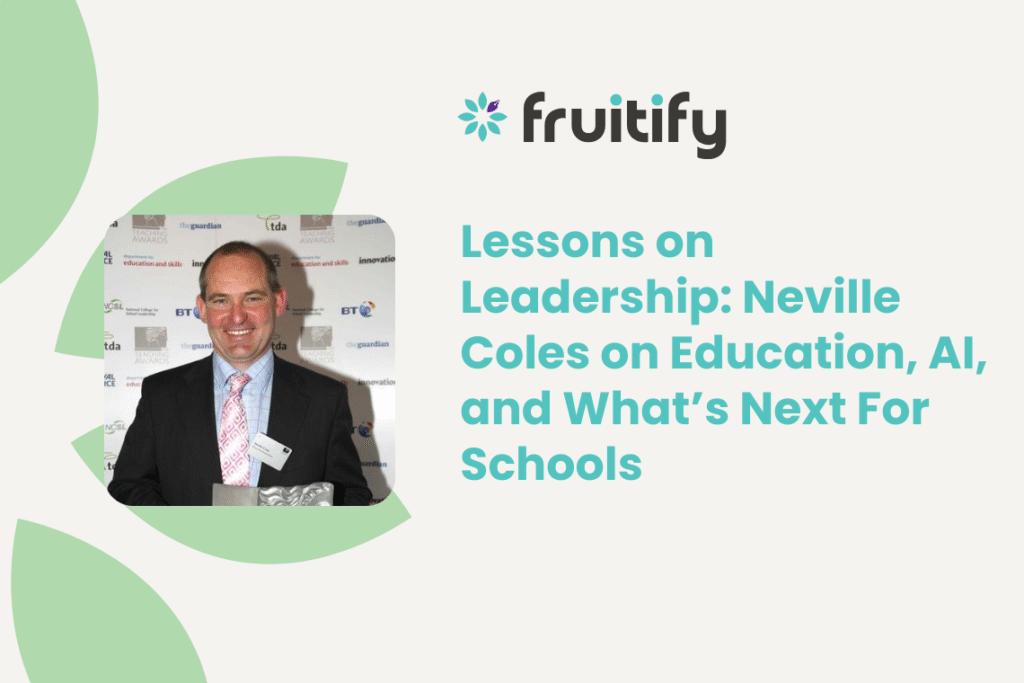
With over 30 years’ experience in education, Neville Coles brings invaluable leadership insight to the Fruitify advisory team. He began teaching in 1988 and went on to serve as a secondary Headteacher and later as CEO of a successful Multi-Academy Trust, leading nine schools and over 5,000 students. Under his leadership, Neville’s school achieved Ofsted Outstanding status in 2014, and he has also worked as an Ofsted inspector and National Leader of Education (NLE), supporting schools and leaders across the UK and beyond. Today, alongside his advisory role with Fruitify, Neville also works as Development Director for The Coreus Group, and chairs The Coreus Foundation, a community interest company driving initiatives across education, health, and conservation. At Fruitify, Neville’s experience as a teacher, school leader, and MAT CEO brings invaluable perspective, ensuring our platform is built around the real challenges and priorities of educators. We asked Neville a few questions about his journey in education, the evolving role of technology and AI in schools, and the potential impact of Fruitify. With a breadth of experience, he offers a grounded perspective on how innovation can genuinely support teachers, and improve learning outcomes. How have you seen the education landscape shift over the last decade, especially with technology? Massively. Schools have often been risk-averse when it comes to adopting new technology. Of course, it’s essential that we protect children and young people from its potential harms, but the best educators recognise that we can’t turn back time. Instead, we need to embrace technology and teach students how to use it wisely. Over the last 20 to 30 years, especially since the rise of the internet, education has been transformed in terms of how we both teach, and learn. However, in many schools, technology still isn’t being used as effectively as it could be. We need thoughtful, mature solutions that meet the needs of a generation that has grown up digitally. What is your perspective on the role AI can (and can’t) play in schools today? AI needs to be approached thoughtfully. It shouldn’t be viewed as a replacement for skilled teachers or support staff, but as a tool to enhance what we do and how we do it. We have only just begun to scratch the surface of what AI can offer and the impact it can have in education. The next 5 to 10 years will likely bring a creative explosion in how it’s used. My hope is that AI can take on more of the routine, time-consuming tasks, such as marking, freeing teachers to focus on what really matters: working directly with students, planning great lessons, and driving meaningful learning forward. From your experience, what are the biggest misconceptions school leaders and teachers have about AI? The biggest misconception is that AI will, or could, replace a teacher. I do not see it this way. I think we should see AI as a way in which students can access even more expert advice and guidance overseen by a teacher or a member of support staff. It also has huge potential to be a game-changing tool to free up time and resources, helping school managers and leaders be even more productive in the running of the school. What role do you see AI playing in supporting teacher wellbeing and retention? It almost goes without saying that if teachers can find ways to spend more time on delivery and less time on tedious, yet vital, marking then the profession will become more attractive. I have yet to find a teacher who enjoys marking! Most enjoy finding what students don’t know and filling the gaps; AI should allow this to happen more often and more efficiently. We fill the right gaps in the right way, with teachers remaining central to this process. We need to exacerbate the joyous part of teaching which will improve teacher wellbeing, and in turn retention within the profession. How can AI tools be introduced in a way that genuinely reduces teacher workload instead of adding “one more system” to manage? It all comes down to the quality, and simplicity, of the AI product. The best tools make teachers’ lives easier, not harder. A great AI solution, like Fruitify’s marking platform, identifies the problem quickly and delivers clear, useful results without adding complexity. When teachers are involved in shaping these tools, the solutions are far more likely to ‘stick’ because they genuinely meet classroom needs. Over time, both the technology and its users learn and improve together, creating a virtuous circle where innovation continuously enhances teaching, rather than interrupting it. What excites you most about what Fruitify is building for teachers and schools? What excites me most about Fruitify is its partnership approach with teachers and support staff to develop a product that truly responds to real classroom needs. Gaining insight and feedback from real teachers will help identify key teacher pain-points which require solutions, and shape a product truly built to help educators. It’s exciting to see how early adopters will shape the platform and guide the team in creating new solutions that build on Fruitify’s innovative approach. How do you see Fruitify helping MATs and individual schools tackle real issues like workload, marking consistency, or student progress? Fruitify’s tools can significantly reduce teacher workload by taking on routine marking tasks, freeing up time for teachers to focus on addressing learning gaps with students, and enabling them to make faster progress. The result is a more enjoyable and productive teaching and learning experience for both students and teachers, which is the overarching mission Fruitify is seeking to achieve. Schools and MATs that fully embrace the platform should expect to gain a competitive advantage in the market by streamlining processes and improving outcomes in the classroom. Where do you think education is heading in the next 5-10 years, and what role will AI play? AI will play a pivotal role in education over the next 5-10 years, and education leaders should seek to fully embrace the technology. Nonetheless,
The 4 Myths About AI in Schools – Debunked
Artificial Intelligence (AI) is reshaping industries worldwide, and education is no exception. While adoption within schools is accelerating, misconceptions often overshadow its immense potential. At Fruitify, we help organisations and institutions integrate and utilise AI responsibly and effectively, and we believe it’s time to separate fact from fiction. Myth 1: “AI makes learning lazy” A common misconception is that introducing AI tools in schools will make students lazy and passive during learning processes, as if AI is doing the work for them. However, with the correct use and integration this could not be further from the truth. Like calculators or the internet before it, AI is a tool, and its impact depends on how it is introduced and guided. When used effectively, to assist active learning, AI can be a learning amplification tool which supports problem-solving, information retention and provides differentiated guidance tailored to individual needs. An Australian study found student response quality improved by 47% over ten weeks when using an AI-feedback tool. Fruitify utilises AI as a tool to augment learning by providing teachers with data insights, performance analysis and personalised feedback to facilitate adaptive learning in the classroom. By pinpointing individual-level and class-level areas needing improvement, Fruitify enables teachers to make real-time adjustments to teaching strategies or content focus to guide student progress. Fruitify isn’t a shortcut, it’s a learning spark to help teachers better engage students and provide improved, targeted learning processes. Myth 2: “AI will replace teachers” As covered in our previous blog (implement link), AI is not a substitute for human educators but a complement to them. AI can streamline administrative tasks, provide instant feedback, and support personalised learning, but it cannot compete with teachers’ abilities to provide empathy, critical thinking and mentorship. AI is not a replacement, but instead a time-saving tool to reduce teacher workloads and let them do what they do best: nurture, inspire, spark creativity and create meaningful connections in the classroom. The Fruitify platform exemplifies this, reducing homework administration, providing instant personalised feedback and student insights to shape future lesson planning and adaptive learning methods. Yet, teachers are still the centre of the platform, with predicted marks accompanied by explainable reasoning and editable teacher feedback, blending automation with human judgement. Myth 3: “AI is too complex for schools to implement” Many still consider AI tools to be complex, unnecessary tools which will complicate and hinder learning, but this is increasingly disproven as evidence shows AI tools can simplify teaching, streamline administration and enhance engagement. Many AI tools are user-friendly and as easy to use as your favourite apps, so schools should not be deterred by complexity myths, but instead embrace the accessibility of such revolutionary learning tools. Fruitify was built with teachers in mind, ensuring the platform is user-friendly with intuitive interfaces designed for non-technical users, ensuring accessibility for all teachers. So, we are here to debunk the AI-complexity myth within education and equip educators with the tools to change their own, and their students, lives for the better. Myth 4: “AI is unsafe or biased, so it shouldn’t be used” Bias within certain AI tools and platforms is a real issue, which can lead to disparities in educational outcomes and biased assessments. However, this is the outcome of insufficient transparency, oversight and training. When managed correctly, AI can be safe, fair, and even more equitable than traditional methods. At Fruitify, we champion fair and responsible technology that supports all learners. Our platform’s marking system is completely anonymised, omitting any student information used in the marking process. This is our way of ‘leveling the playing field’, avoiding any subconscious bias present in teacher marking, to facilitate a bias-free marking process which gives every learner an equal opportunity for success and achievement. Final Thoughts AI is not a threat to education, it is a powerful tool to enhance it. When introduced responsibly, AI can free teachers from administrative burden, personalise learning at scale, and close achievement gaps. At Fruitify, our focus is on helping schools and organisations adopt AI ethically and strategically, to achieve lasting positive impacts within education. Artificial Intelligence (AI) is reshaping industries worldwide, and education is no exception. While adoption within schools is accelerating, misconceptions often overshadow its immense potential. At Fruitify, we help organisations and institutions integrate and utilise AI responsibly and effectively, and we believe it’s time to separate fact from fiction. Myth 1: “AI makes learning lazy” A common misconception is that introducing AI tools in schools will make students lazy and passive during learning processes, as if AI is doing the work for them. However, with the correct use and integration this could not be further from the truth. Like calculators or the internet before it, AI is a tool, and its impact depends on how it is introduced and guided. When used effectively, to assist active learning, AI can be a learning amplification tool which supports problem-solving, information retention and provides differentiated guidance tailored to individual needs. An Australian study found student response quality improved by 47% over ten weeks when using an AI-feedback tool. Fruitify utilises AI as a tool to augment learning by providing teachers with data insights, performance analysis and personalised feedback to facilitate adaptive learning in the classroom. By pinpointing individual-level and class-level areas needing improvement, Fruitify enables teachers to make real-time adjustments to teaching strategies or content focus to guide student progress. Fruitify isn’t a shortcut, it’s a learning spark to help teachers better engage students and provide improved, targeted learning processes. Myth 2: “AI will replace teachers” As covered in our previous blog (implement link), AI is not a substitute for human educators but a complement to them. AI can streamline administrative tasks, provide instant feedback, and support personalised learning, but it cannot compete with teachers’ abilities to provide empathy, critical thinking and mentorship. AI is not a replacement, but instead a time-saving tool to reduce teacher workloads and let them do what they do best: nurture, inspire, spark creativity and create meaningful connections in
Why AI Should Assist Teachers, Not Replace Them
With the global rise of AI permeating into the education sector globally, some worry it could edge overworked teachers out of the classroom, but we disagree. AI doesn’t have to be a job-stealer, it can be an ally. Here’s why:
Transforming Teaching with AI Technology
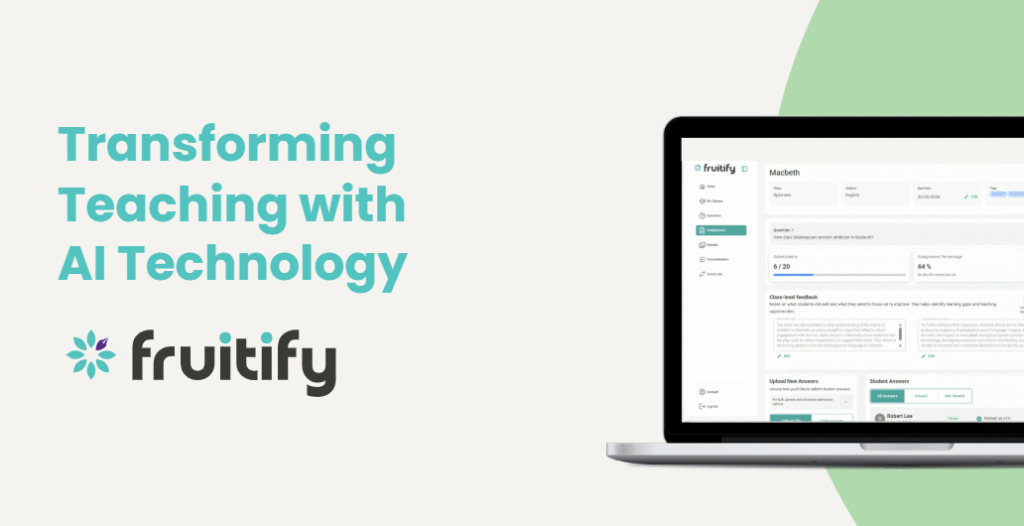
Today marks the launch of Fruitify, an innovative platform dedicated to transforming education through technology. Our groundbreaking AI-powered platform is built for educators: grading assignments in seconds, offering personalised feedback, and generating data-driven insights to boost student progress.